Your deposit usually has no financing condition
Sign the private contract, then hear no from the bank, and the deposit is usually gone. If the contract calls it a penalty deposit (arras penitenciales), a seller who backs out pays it back double.
Mortgage in Spain
The contract for a new build usually has no financing condition. So check in two minutes what a Spanish bank is likely to lend you, then have it confirmed in a mortgage report by people who work at banks in Spain.
 JaineFree, 2 minutes
For Villa in Lorca: its region and lowest price are already filled in.


Before you sign
With a new build, money goes out long before a bank says yes. Three things catch people out.
Sign the private contract, then hear no from the bank, and the deposit is usually gone. If the contract calls it a penalty deposit (arras penitenciales), a seller who backs out pays it back double.
What you pay while the home is built goes into an account guaranteed by law, but no bank lends it. The mortgage only starts at completion.
If the valuer finds less than the price, the loan gets smaller and the gap is yours. Taxes and costs come on top.
In 90 seconds
Property Guidance Network's own video. They do the check and the report.
The figures
Whichever is lower. Bankinter lends non-residents up to 60%. Residents of Spain can get up to 80%.
Bankinter; Expatica, 2 November 2026Non-residents usually get 15 to 25 years. Sabadell goes up to 30, depending on your age.
Bankinter; Banco SabadellNew mortgages in August 2026, all borrowers. 64.1% of them were fixed. Non-residents usually pay a little more.
INE, August 2026October 2026. A variable rate is Euribor plus the bank's margin, usually reviewed once a year.
Banco de España, 3 November 2026A worked example
Here the bank lends 70% of the price. The other 30%, the taxes and the costs come from your own money. The payment is worked out at 3.2% fixed over 25 years, close to the average fixed rate in Spain.
Worked out for Villa in Lorca, from its lowest price.
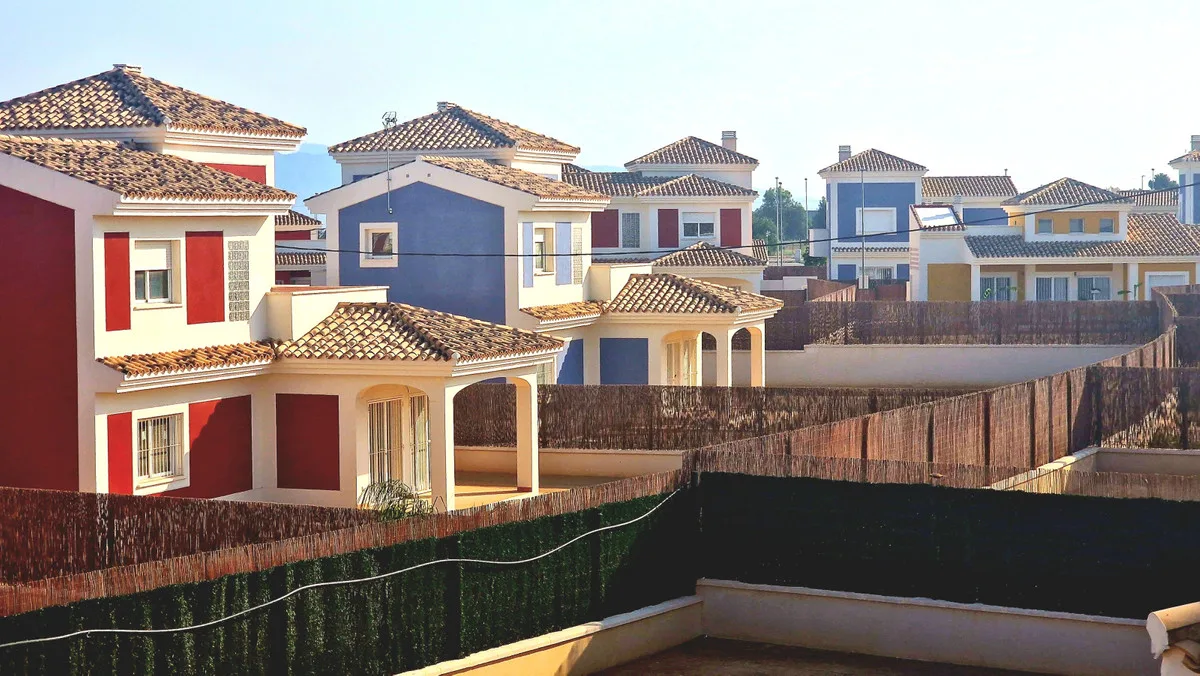 Villa in Lorca
From check to keys
The stage payments during the build come from your own money, guaranteed by law. The bank lends only at completion, on its own valuation of the finished home.
Before you reserve or sign anything that binds you.
A deposit takes the home off the market.
Documents in, several banks asked, a plan back. Best before the contract.
Usually without a financing condition. Stage payments start, into a guaranteed account.
Your Spanish tax number and a Spanish account, both needed before the deed.
Near completion the bank values the finished home. Allow several weeks for approval.
At least 10 days to read it, and a free meeting with a notary.
Deed and mortgage signed the same day. Or you take over the developer's loan, if the bank agrees.
The steps where the mortgage plays a part
Some buyers remortgage or release equity at home instead of borrowing in Spain. That can make the stage payments easier, but it puts your UK home at stake and adds currency risk.
What you get

An indication in two minutes
Once, VAT included. You pay only when it is ready.
Often yes. Spanish banks usually lend non-residents 60 to 70% of the price or the valuation, whichever is lower, for up to about 25 years. They look at your income, your debts, two years of tax returns and your age when the loan ends: our check assumes it is repaid before 75. The free check shows in two minutes how that looks for you.
With a 70% mortgage you bring 30% of the price yourself, plus every tax and cost: 10% VAT and the region's stamp duty (AJD) on a new build, notary and registry, a valuation and about 1% for your own lawyer. In the worked example above, a home of €350,000 on the Costa del Sol needs about €150,000 of your own money. Much of it is needed early, because the stage payments during the build come from your own money.
Check before you reserve, and apply in earnest well before completion. The private contract usually has no financing condition, so you want to know what a bank will lend before you sign it. The mortgage itself is signed at the notary on completion, after the bank has valued the finished home. Approval usually takes several weeks.
That depends on how much certainty you want. In August 2026 new mortgages in Spain averaged 3.16% fixed and 2.95% variable, and 64.1% were fixed. A variable rate is Euribor plus a margin, usually reviewed once a year, and Spanish law does not allow a floor on it. Non-residents usually pay a little more than these averages.
Yes, both before the deed. The NIE is your Spanish tax number: you apply through a Spanish consulate, or a representative in Spain does it for you. Arrange the NIE and the account well before completion, so they do not hold up the notary.
The bank lends on the lower of the two. If a home of €350,000 is valued at €330,000, 70% comes to €231,000 instead of €245,000, and you bring the €14,000 difference yourself. Keep a buffer in your own money for that.
Photos via Pexels: Kampus Production, Pavel Danilyuk, RDNE Stock project.
Give me ten answers and I will tell you how a Spanish bank is likely to look at your plans.
Two minutes, no documents. Your answers go to Property Guidance Network, who do the scan and the report.
Bankinter: mortgages for non-residents · Expatica: non-resident mortgages in Spain (2 November 2026) · Banco Sabadell: mortgages · INE: mortgages, August 2026 · Banco de España: Euribor, October 2026 · BOE: Ley 5/2019 on real-estate credit · Banco de España: which mortgage costs you pay · Banco de España: buying off-plan and the developer's loan