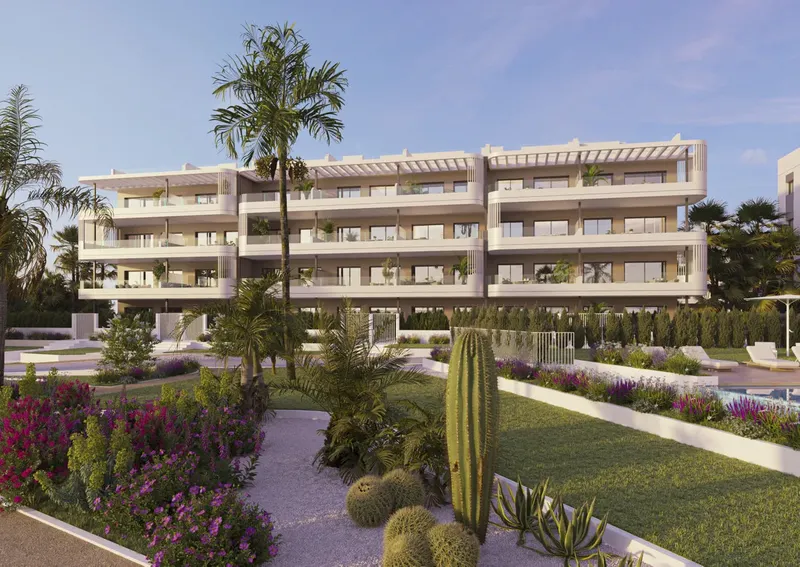
San Roque
Townhouses and villas in Sotogrande
Value 394 of 6 basics included
- From
- €1,014,000
- Status
- 18 of 19 available

Buying guide · Checked on 22 November 2026
Buying off-plan works differently from buying an existing home. This guide follows the order of a real purchase, from the NIE number to the keys, with the costs per region, the protection the law gives you and the tax at home for British, Dutch and Belgian buyers.
01 · Start here
Yes: buyers from the UK, the Netherlands, Belgium and elsewhere can buy a home in Spain, with an NIE number and, in practice, a Spanish bank account. Owning a home does not give you the right to live there.
Buying property in Spain as a foreigner is common, and the steps are the same for everyone. You get an NIE number, open a Spanish bank account and take your own lawyer. For a new build you then reserve a home, sign a private purchase contract, pay in stages while it is built and sign the deed at the notary when it is finished.
Since 3 April 2025 Spain no longer gives a golden visa for buying property. EU citizens may live in Spain anyway. British buyers can stay up to 90 days in any 180 without a visa; for longer they need one, such as the non-lucrative visa. Section 9 explains what this means for each country.
A proposal for a tax of up to 100% on homes bought by non-EU buyers who do not live in Spain stalled in Congress in March 2026. It has not been withdrawn, so ask your lawyer for the state of play before you sign.
La Moncloa: end of the golden visa · GOV.UK: How to buy property in Spain
Count on about 12 to 14% on top of the price of a new build on the Spanish mainland: 10% VAT, 1.2 to 1.5% stamp duty depending on the region, and about 1 to 2% for the notary, the land registry and your lawyer.
These are the costs of buying property in Spain when the seller is the developer. On a EUR 300,000 home in Andalucía that is EUR 30,000 VAT, EUR 3,600 stamp duty and about EUR 4,000 to 5,000 in fees: roughly 13% in total. In Valencia the stamp duty is EUR 4,200, in Murcia EUR 4,500.
A mortgage adds its own costs, such as the valuation. Ask the developer whether the list price includes VAT, and ask for a written cost overview before you reserve.
See the worked example per region
Agencia Tributaria: the reduced 10% VAT rate · Guía Fiscal: transfer tax and stamp duty in Andalucía · TaxDown: transfer tax and stamp duty in the Comunitat Valenciana · Guía Fiscal: transfer tax and stamp duty in Murcia
A new build costs more in tax, because you pay 10% VAT plus stamp duty instead of 7 to 9% transfer tax in the main coastal regions. In return you get a legal guarantee on your payments, the builder's warranties and time to pay in stages.
With a resale you buy from the current owner and pay transfer tax (ITP): 7% in Andalucía, 9% in Valencia and 7.75% in Murcia. With a new build you buy from the developer and pay VAT and stamp duty, which together come to 11.2 to 11.5% in those regions.
What you get for that difference: a home nobody has lived in, stage payments covered by a bank guarantee or insurance, and the 10, 3 and 1 year warranties, which run from the end of the works. A resale is ready now but has whatever is left of its warranties, if anything.
Key-ready new builds sit in between: finished, so no waiting and no stage payments, but still sold by the developer with VAT.
Guía Fiscal: transfer tax and stamp duty in Andalucía · TaxDown: transfer tax and stamp duty in the Comunitat Valenciana · Guía Fiscal: transfer tax and stamp duty in Murcia · BOE: Ley 38/1999 de Ordenación de la Edificación (LOE)
From reservation to the private purchase contract usually takes a few weeks; after that the build sets the pace, and the contract states the delivery date. A key-ready home is quicker, because only the paperwork is left.
Start the paperwork before you find the home. An NIE number from a Spanish consulate takes some time: the consulate in Amsterdam, for example, works by appointment and normally sends it within two weeks. Opening a bank account and finding a lawyer can run alongside.
If you need a Spanish mortgage, the bank must give you its binding offer at least 10 days before you sign, so plan the notary date with that in mind. After the deed come the land registry, the utilities and your yearly taxes.

02 · Getting ready
The NIE (número de identidad de extranjero) is the tax identification number every foreign buyer needs to sign the contract and the deed, pay the taxes and register the home. You apply with form EX-15 and a small fee, at a Spanish consulate, in Spain or through a representative.
How to get a Spanish NIE: fill in form EX-15 and pay the fee with form 790, code 012. You apply at the Spanish consulate in your own country, in person in Spain, or through a representative with a power of attorney, often your lawyer.
Book early. The consulate in Amsterdam, for example, works by appointment and normally sends the NIE by email within two weeks. Each buyer needs their own, so a couple buying together applies twice.
The NIE is a number for tax and paperwork. It is not a residence permit and does not let you stay longer in Spain.
Consulate of Spain in Amsterdam: NIE · GOV.UK: How to buy property in Spain
In practice you need one: the IBI property tax, the community fees and the electricity and water bills are paid from a Spanish account, usually by direct debit.
You can open a Spanish bank account as a non-resident. The bank asks for your NIE and passport and wants to know where your money comes from, so have payslips or tax returns at hand. Ask your lawyer which banks work well with owners who live abroad.
Keep enough on the account for the yearly bills. When you send money from pounds or another currency, look at both the fee and the exchange rate you get: together they are the real cost of the transfer.
Take an independent lawyer who works only for you, not for the developer or the agent. The notary is a public official who makes the deed valid, but does not check the deal on your behalf.
Your lawyer checks what you cannot check from home: the building licence, the bank guarantee, the nota simple from the land registry and the contract itself. They can also apply for your NIE, sign for you with a power of attorney and handle the taxes after the deed.
Choose the lawyer yourself and agree the fee in writing before they start. Be careful with a lawyer recommended by the seller: they may be good, but they are not independent.
You can buy property in Spain without travelling: with a power of attorney (poder notarial), your lawyer or someone you trust signs for you in Spain.
You sign the power of attorney before a notary, at home or at a Spanish consulate. Your lawyer tells you what the Spanish notary needs to accept a document signed abroad, such as a translation or a legalisation.
Give a power for this purchase only, not a general one, and name what it covers: the NIE, the bank account, the contract, the deed and a mortgage if you take one. Ask your lawyer to end it when the purchase is done.
Try to see the home yourself at handover, or send someone independent to inspect it for you. Signing from home is easy; spotting defects from home is not.


03 · Financing
Spanish banks usually lend non-residents 60 to 70% of the price or the valuation, whichever is lower, over up to 25 years (some banks 30), to be repaid by about age 75.
On a new build the mortgage is signed at the notary, together with the deed, when the home is finished. Until then you pay the reservation and the stage payments from your own money. So the question is not only what a bank will lend, but whether you can bring the rest in time.
Spanish mortgage rates: according to INE, the Spanish statistics office, the average fixed rate on home mortgages was 3.16% in August 2026. Your own rate depends on the bank and your file. By law (Ley 5/2019) the bank must give you its binding offer at least 10 days before you sign.
Some buyers borrow in their own country instead, for example against the home they already own, which can pay for the stage payments long before a Spanish mortgage pays out. Lending against the Spanish home itself is harder: in the Netherlands, for example, few lenders do it.
Borrowing at home puts the money in your hands before the build starts, in your own currency. The price is that your home or your income at home carries the loan, so a delay in Spain does not delay the repayments at home.
Tax differs per country. In the Netherlands a loan for a Spanish home is a box 3 debt: the interest is not deductible in box 1. Ask an adviser at home how your country treats it before you borrow.
Some buyers combine both: money from home for the stage payments, a Spanish mortgage at the deed. The mortgage page sets out the options side by side.
Everything you pay before completion, the reservation and every stage payment, comes from your own money; a Spanish mortgage only pays out at the notary. If you earn pounds or another currency, each payment also carries an exchange-rate risk.
The price is fixed in euros, but each stage is paid on its own date, at that day's exchange rate. Over the months of the build the pound or another currency can move against the euro, so the same euro amount can cost you more, or less, than you planned.
Plan a buffer for that, and compare how you send the money. Some currency providers can fix a rate now for a payment later; ask what it costs and what happens if a stage date moves.
As a rough plan with a 70% mortgage: bring about 30% of the price yourself, plus the 12 to 14% of taxes and costs.

A question about this part?
Stuck on this step? Ask Jaine. Tell her your budget and wishes and she shows the new-build projects that fit, and a partner on the spot can answer the rest.
Ask Jaine
04 · The purchase
A reservation takes the home off the market for a small amount, usually about EUR 3,000 to 6,000, until you sign the private purchase contract a few weeks later.
Read the reservation form before you pay, or better, let your lawyer read it. Check how long the home is held, whether the price is fixed for that time, and when you get the money back if no contract follows.
The guarantee on your payments only starts once the building licence has been granted. Money paid before that is not covered. So if a project has no licence yet, pay no more than the reservation until it does.
BOE: Ley 38/1999 de Ordenación de la Edificación (LOE) · Banco de España: guarantee on payments for homes under construction
The private purchase contract (contrato privado de compraventa) binds you and the developer: it fixes the home, the price, the payment schedule and the delivery date, and it must name the guarantor and the special account for your payments.
You usually sign it a few weeks after the reservation and pay a larger deposit, often 20 to 30% of the price including the reservation. From the building licence onward that payment and every later one must be guaranteed, and the guarantee must be handed to you when you sign.
Have your lawyer check the details that matter later: the delivery date and any extra time the developer allows itself, what happens if that date is missed, the specifications of the home, whether the price includes VAT, and what comes with it, such as a parking space or a storage room.
While the home is built you pay in stages that follow the building schedule. From the building licence onward, each payment must go into a special account and be covered by a bank guarantee or insurance in your name.
A common schedule is a reservation, a deposit at the private contract, payments during the build and the balance at the notary. The shares differ per developer, so compare them between projects: the more you pay at the end, the less you have at risk during the build.
For every payment you should receive a guarantee certificate for that amount, from the bank or insurer named in the contract. Pay only into the special account named in the contract, and keep each receipt with its certificate.
Paying from pounds or another currency? Each stage is a separate exchange: see Stage payments and currency under Financing.
BOE: Ley 38/1999 de Ordenación de la Edificación (LOE) · Banco de España: guarantee on payments for homes under construction
When the home is finished you sign the deed (escritura pública) before a Spanish notary, pay the balance and receive the keys. From the deed the home is yours.
Before you sign, the home needs its first-occupation licence, or in some regions a declaración responsable instead. Ask your lawyer to check that it exists, together with the other documents listed below.
If you have a Spanish mortgage, you sign it at the same appointment. If you cannot be there, your representative signs with the power of attorney. After the deed your lawyer files the stamp duty and sends the deed to the land registry.
After the deed, the home is registered in your name at the land registry (Registro de la Propiedad). You own it from the deed; registration makes your ownership public and protects it.
Your lawyer or the notary sends the deed to the registry once the stamp duty is paid. Ask for the registered deed or a new nota simple afterwards, so you can see the home in your name.
Then you set up the home: electricity and water in your name, the IBI property tax and the waste fee by direct debit, and your place in the owners' community. From the year of the deed you file the non-resident tax return, modelo 210, every year. Belgian buyers also report the home at home within four months: see section 9.
A key-ready home is finished and has its first-occupation licence, so you skip the stage payments and the wait: you reserve, inspect the home and pay the price at the notary.
It is still the first sale by the developer, so the taxes are those of a new build: 10% VAT plus the regional stamp duty. Because the home is finished, there is no build to guarantee, so keep what you pay before the notary small.
The warranties run from the end of the works, not from your purchase, so a home finished some time ago has less left of its 1-year warranty for finishes. Inspect it as carefully as an off-plan home, and ask how long it has stood empty.
BOE: Ley 38/1999 de Ordenación de la Edificación (LOE) · Agencia Tributaria: the reduced 10% VAT rate
 A project on this sitePenthouse in Fuengirola
05 · Protection
Spanish law protects your stage payments: from the building licence onward, every payment for an off-plan home must go into a special account and be covered by a bank guarantee (aval) or insurance policy in your name, for the money paid plus legal interest.
The rule is in the Spanish building law, Ley 38/1999 (LOE), first additional provision. Since 1 January 2016 it has replaced the old Ley 57/1968. Each buyer gets an individual guarantee, the contract names the guarantor and the account, and the guarantee must be handed over when you sign.
What is not covered: money paid before the building licence was granted. That is why you pay no more than a reservation until the licence exists. Pay only into the special account named in the contract.
The guarantee ends when the first-occupation licence is issued and the home is handed over to you. A bank guarantee also lapses two years after the developer breaks the contract if you have not claimed by then, so act early if things go wrong.
BOE: Ley 38/1999 de Ordenación de la Edificación (LOE) · Banco de España: guarantee on payments for homes under construction
If building has not started or the home is not delivered on the agreed date, you can cancel and get back what you paid with legal interest, or agree a new date with the developer.
When you cancel, the developer has 30 days to repay you. If it does not, you claim from the bank or insurer that gave the guarantee. An insurer must pay within 30 days of your claim; the law sets no deadline for a bank. Your lawyer sends the claim with the contract, the certificates and the receipts.
A bank guarantee lapses two years after the developer's breach if you have not claimed, so do not wait to see how things go. If you agree an extension instead, put it in writing and have your lawyer check that your guarantee still covers the new date.
BOE: Ley 38/1999 de Ordenación de la Edificación (LOE) · Banco de España: guarantee on payments for homes under construction
Before you sign the deed, inspect the home and have every defect written down on a snagging list. The developer repairs them, and you check the repairs.
Walk through every room with the specifications from your contract in hand. Check walls, floors and tiles, doors and windows, taps, drains and showers, the electrics and every socket, the air conditioning, and how the terraces drain water. Photograph what you find and date it.
If you cannot come, send an independent inspector or your lawyer. Agree in writing when open points will be repaired. Defects in the finishes that show up later fall under the 1-year warranty, which runs from the end of the works, so report them quickly and in writing.
Spanish building law gives three warranties: 10 years for the structure, 3 years for defects that affect habitability and 1 year for finishes. They run from the day the developer accepts the works from the builder, not from your handover.
Because the clock starts at the end of the works, part of the first year can be gone before you get the keys. That matters most for a key-ready home that has stood finished for a while. Report defects in the finishes in writing as soon as you see them.
Only the 10-year insurance for the structure is compulsory for housing. Ask for the policy at completion and keep it with the building book: it also protects a later owner if you sell within the ten years.
| Warranty | Covers | Insurance compulsory |
|---|---|---|
| 10 years | The structure: foundations, beams, load-bearing walls | Yes, for housing |
| 3 years | Defects that affect habitability, such as damp or poor insulation | No |
| 1 year | Finishes | No |
Ley 38/1999 (LOE), articles 17 and 19. The periods run from the acceptance of the works (recepción de la obra).
 A project on this siteVilla in New Golden Mile
06 · Taxes and costs
On a new build you pay 10% VAT (IVA) to the developer plus stamp duty (AJD) to the region: 1.2% in Andalucía, 1.4% in Valencia and 1.5% in Murcia, at the general rates for a second home.
The 10% VAT applies to the first sale of a home by a developer, including up to two parking spaces and annexes sold with it. Plots and commercial units pay 21%. On the Canary Islands a different tax, IGIC at 7%, replaces VAT.
Stamp duty has changed recently. Valencia lowered it to 1.4% from 1 June 2026 (1.5% before) and Murcia to 1.5% from 25 July 2025 (2% before). Reduced rates exist for a main home, but holiday buyers generally do not get them.
| Region | VAT, new build | Stamp duty (AJD) | Resale: transfer tax (ITP) |
|---|---|---|---|
| Andalucía (Costa del Sol, Costa de Almería) | 10% | 1.2% | 7% |
| Comunitat Valenciana (Costa Blanca) | 10% | 1.4% | 9%, 11% above EUR 1 million |
| Región de Murcia (Costa Cálida) | 10% | 1.5% | 7.75% |
General rates in November 2026. The Valencian rates apply from 1 June 2026.
Agencia Tributaria: the reduced 10% VAT rate · Guía Fiscal: transfer tax and stamp duty in Andalucía · TaxDown: transfer tax and stamp duty in the Comunitat Valenciana · Guía Fiscal: transfer tax and stamp duty in Murcia
The notary, the land registry and your lawyer together usually cost about 1 to 2% of the price. The notary and the registry charge fixed official tariffs; the lawyer's fee is agreed with them.
As a rough guide for a EUR 300,000 home, the notary is often EUR 400 to 1,000 and the registry EUR 200 to 700, before extras and VAT. Copies and extra pages add to the bill.
Ask your lawyer for a written quote that says what is included: the checks before you sign, the deed, the taxes afterwards and the registration. A fixed fee is easier to compare than a percentage.
On a EUR 300,000 new build you pay about EUR 37,600 to 39,500 on top of the price, roughly 13%, depending on the region and the fees.
The VAT is the same everywhere on the mainland: EUR 30,000. The stamp duty depends on the region. The fees for the notary, the land registry and your lawyer are an estimate of EUR 4,000 to 5,000.
With a mortgage you add the bank's valuation and any costs the bank charges, and you need the cash for the stage payments before the mortgage pays out. The mortgage page works this out for a project you choose.
| EUR 300,000 new build | Andalucía | Valencia | Murcia |
|---|---|---|---|
| VAT 10% | 30,000 | 30,000 | 30,000 |
| Stamp duty | 3,600 (1.2%) | 4,200 (1.4%) | 4,500 (1.5%) |
| Notary, registry, lawyer | 4,000 to 5,000 | 4,000 to 5,000 | 4,000 to 5,000 |
| Total on top | 37,600 to 38,600 | 38,200 to 39,200 | 38,500 to 39,500 |
| Share of the price | about 13% | about 13% | about 13% |
Amounts in euros, without a mortgage. General rates for a second home in November 2026.
Agencia Tributaria: the reduced 10% VAT rate · Guía Fiscal: transfer tax and stamp duty in Andalucía · TaxDown: transfer tax and stamp duty in the Comunitat Valenciana · Guía Fiscal: transfer tax and stamp duty in Murcia
An existing home pays transfer tax (ITP) instead of VAT and stamp duty: 7% in Andalucía, 9% in Valencia and 7.75% in Murcia. On EUR 300,000 that is EUR 7,200 to 12,600 less tax than a new build.
The new build costs more in tax, but buys you things a resale does not offer: a guarantee on what you pay during the build, the full 10, 3 and 1 year warranties from the end of the works, and a home nobody has lived in. A resale is available now and can be viewed as it is.
In Valencia the transfer tax rises to 11% above EUR 1 million. The notary, the registry and your lawyer come on top in both cases.
| EUR 300,000 | New build: VAT and stamp duty | Resale: transfer tax | Difference |
|---|---|---|---|
| Andalucía | 33,600 | 21,000 (7%) | 12,600 |
| Valencia | 34,200 | 27,000 (9%) | 7,200 |
| Murcia | 34,500 | 23,250 (7.75%) | 11,250 |
Amounts in euros, tax only, general rates in November 2026.
Guía Fiscal: transfer tax and stamp duty in Andalucía · TaxDown: transfer tax and stamp duty in the Comunitat Valenciana · Guía Fiscal: transfer tax and stamp duty in Murcia
Projects
San Roque
Value 394 of 6 basics included
Key ready: Alacant/Alicante
Value 53ready to move in
 A project on this siteApartment in Manilva
07 · Owning it
IBI is the yearly property tax of the town hall: each town sets a rate between 0.4% and 1.1% of the cadastral value. Since 10 April 2025 town halls must also charge a separate waste fee that covers the real cost, so it differs by town.
The cadastral value (valor catastral) is set by the Catastro, not by the market, and is shown on your IBI bill. A new home may not have one yet in its first year. Until you have a first bill, ask what similar homes in the development or the town pay.
Pay both by direct debit from your Spanish account, so a bill sent to an empty home is not missed. Towns in stressed housing markets may raise the IBI on homes let to tourists.
If the development has shared areas, such as a pool, gardens or a lift, you pay community fees to the owners' community. The owners set them in a yearly budget, so ask for that budget before you buy.
In a new development the community may not have met yet, and the first budget is an estimate. Ask the developer what it is based on, what it covers and how it is split between the homes.
The community also decides on house rules, including tourist lets in an apartment building. It can charge an owner who starts a new tourist let up to 20% more in fees: see Renting it out.
As a non-resident owner you file a Spanish tax return, modelo 210, every year, even if you never let the home. You pay tax on an imputed income of 1.1% or 2% of the cadastral value, at 19% if you live in the EU or EEA and 24% if you live elsewhere, including the UK.
The rate is 1.1% if the town's cadastral values were revised from 2012 onward, otherwise 2%. Without a cadastral value it is 1.1% of half the purchase price. No costs are deducted. A home that is still being built has no imputed income, and the days you let it are taxed as rental income instead.
New filing dates (Orden HAC/623/2026): the imputed income for 2026 is filed from 1 April to 31 December 2027. Rental income is filed once a year, from 1 to 20 April of the following year; one annual return for 2026 is filed from 1 to 20 April 2027. Many owners let a lawyer or tax adviser (gestor) file it.
Agencia Tributaria: imputed income on a home for own use (non-residents) · Agencia Tributaria: tax rates for non-residents
Non-residents pay Spanish wealth tax only on their Spanish assets above EUR 700,000, and a separate solidarity tax applies above EUR 3 million. Inheritance tax is paid by each heir, not by the estate.
Regions can set their own reliefs on wealth tax. Whether a regional relief applies to you as a non-resident depends on the region and on where you live, so have it checked if your Spanish assets come near EUR 700,000.
For inheritance tax, the Spanish tax office says every heir can choose between the state rules and the regional rules. When the owner lived outside Spain, the region is the one where most of the Spanish assets are. Ask an adviser which choice gives the lower tax.
Many owners make a Spanish will for the Spanish home, which makes things simpler for the heirs. Ask your lawyer to draw it up together with the purchase.
Agencia Tributaria: inheritance and gift tax for non-residents, questions · BOE: Ley 29/1987 del Impuesto sobre Sucesiones y Donaciones
When you sell as a non-resident you pay 19% Spanish tax on the gain. The buyer holds back 3% of the price and pays it to the tax office on your account, and you set it off against the tax due.
The buyer pays the 3% with form 211 within one month of the sale. You then declare the gain on modelo 210 and set off what was held back; if the 3% is more than the tax, you can claim the difference back. The gain is the sale price minus what you paid, under the Spanish rules.
The town hall also charges its own tax on the rise in land value (plusvalía municipal); ask your lawyer what it will be. If you live in the UK, the gain may be taxed there too, with relief for the Spanish tax: see Your own country.
Agencia Tributaria: gain on the sale of a property by a non-resident · GOV.UK: If you're taxed twice (Foreign Tax Credit Relief)

08 · Renting it out
To let a home to tourists you first register it with the region. In Andalucía that is an entry in the regional tourism register (Decreto 31/2024); in Valencia a registration after a town-hall report, valid for 5 years (Decreto-ley 9/2024).
Towns can limit the number of tourist lets. If rental income is part of your plan, ask before you reserve whether a licence is possible for that home in that town. Murcia has its own rules; ask locally.
The national short-let register (Real Decreto 1312/2024) was annulled by the Supreme Court on 19 May 2026, because the state lacked the power to create it. The regional registration still applies. What the letting platforms ask for can change, so check before you list the home.
Poder Judicial: Supreme Court annuls the national short-let register
Since 3 April 2025 a new tourist let in an apartment building needs the prior approval of three fifths of the owners, and the community can raise that owner's fees by up to 20%. Tourist lets that already existed are protected.
This matters most in a new development, where the community is still forming. If you plan to let to tourists, ask the developer whether the community's rules already say something about it, and have it put to a vote early if you can.
Letting for longer, to someone who lives in the home or stays for a season, is not a tourist let and is not covered by this rule.
Rental income is taxed in Spain: 19% on the net income, after costs, for residents of the EU or EEA, and 24% on the gross income for everyone else, including UK residents.
You declare it on modelo 210. Under the new filing order, rental income is filed in April each year, starting with the income from October to December 2026. For the days the home is not let, the imputed income applies as usual.
VAT on short lets: according to the Spanish tax office, from 1 December 2026 furnished homes let for up to 30 nights to the same guest pay 10% VAT, under Real Decreto-ley 29/2026. It does not apply to the owner's own main home. Ask a tax adviser what this means for your let before you take bookings.
Agencia Tributaria: tax rates for non-residents · Agencia Tributaria: Real Decreto-ley 29/2026, VAT on short lets
Letting to a tenant who makes the home their main residence falls under the Spanish tenancy law (LAU): the tenant can extend the lease year by year up to 5 years with a private landlord. No tourist licence is needed.
That protection is good for the tenant and means you cannot simply take the home back for your own holidays. Lets for a season, for example to someone who stays for the winter or for work, are a different kind of lease under the same law.
The tax is the same as for any rent: 19% on the net income for EU and EEA residents, 24% on the gross income for others. A long let of a home stays exempt from VAT.
BOE: Ley 29/1994 de Arrendamientos Urbanos (LAU) · Agencia Tributaria: tax rates for non-residents

09 · Your own country
As a UK resident you pay Spanish non-resident tax at 24%, without deducting costs from rental income, and you can stay in Spain for up to 90 days in any 180 without a visa. Spanish income and gains also go on your UK tax return, where you can usually claim credit for the Spanish tax.
In Spain: the UK is outside the EU and EEA, so you pay 24% on the imputed income of the home and 24% on gross rent, with no costs deducted. On a gain when you sell, the rate is 19%, the same for every non-resident, and the buyer holds back 3% of the price.
In the UK: if you are UK resident you normally pay tax on foreign income, including rental income on overseas property, and declare it on Self Assessment. HMRC says you can usually claim Foreign Tax Credit Relief for the Spanish tax, though not always the full amount. Gains on property abroad can be taxed in both countries. Have it checked by a UK tax adviser.
Staying: the 90 days in any 180 count across the whole Schengen area, and overstaying can lead to a ban of up to 3 years. To stay longer you need a visa, for example the non-lucrative visa if you will not work in Spain. Since 3 April 2025 buying a home no longer gives a golden visa.
Pound to euro: the price is fixed in euros, but you pay the stages over the months of the build, each at that day's rate. Plan a buffer or fix rates in advance. And keep an eye on the proposed tax of up to 100% on homes bought by non-EU buyers who do not live in Spain: it stalled in Congress in March 2026 but has not been withdrawn.
GOV.UK: How to buy property in Spain · GOV.UK: Spain travel advice, entry requirements · GOV.UK: Tax on foreign income · GOV.UK: If you're taxed twice (Foreign Tax Credit Relief) · La Moncloa: end of the golden visa · Agencia Tributaria: tax rates for non-residents
Dutch residents declare the Spanish home in box 3, among other assets. For 2026 it counts at its value with vacant possession on 1 January 2025, with an assumed return of 6.00%, taxed at 36%, and EUR 59,357 tax-free per person. A loan for it is a box 3 debt, not a box 1 deduction.
The 1971 tax treaty between the Netherlands and Spain gives a reduction of the Dutch box 3 tax for the Spanish home, in proportion to its share of your assets. A new treaty has been agreed but is not yet in force, so ask an adviser what it will change for you.
In Spain you pay the EU rate of 19%, on the imputed income and on net rent with costs deducted. Few Dutch lenders lend against a Spanish home, so the options are savings, a Spanish mortgage or a loan against a home in the Netherlands.
As an EU citizen you may live in Spain. If you stay longer than three months, you usually have to register as a resident.
Belastingdienst: assets and debts in box 3, 2026 · Agencia Tributaria: imputed income on a home for own use (non-residents)
Belgian residents report the Spanish home to the AAPD through MyMinfin within 4 months of the purchase. The FOD Financiën then sets a cadastral income (KI) for it, which goes in your tax return: exempt under the treaty, but counted for the rate on your other income.
This is called exemption with progression (vrijstelling met progressievoorbehoud). If you do not report the home, fines of EUR 250 to 3,000 can follow.
A Spanish bank account must also be reported: to the central contact point (CAP) of the National Bank of Belgium, and in your tax return.
In Spain you pay the EU rate of 19%, on the imputed income and on net rent with costs deducted. As an EU citizen you may live in Spain; staying longer than three months usually means registering as a resident.
FOD Financiën: cadastral income for a home abroad · National Bank of Belgium: central contact point (CAP) · Agencia Tributaria: imputed income on a home for own use (non-residents)
Questions
Yes. British, Dutch, Belgian and other foreign buyers can buy a home in Spain. You need an NIE number and, in practice, a Spanish bank account, and it is wise to take your own lawyer. Buying a home does not give you residence: the golden visa ended on 3 April 2025.
Fill in form EX-15 and pay the small fee with form 790, code 012. Apply at a Spanish consulate in your own country, in person in Spain, or through a representative with a power of attorney. The consulate in Amsterdam, for example, normally sends it within two weeks.
On a new build, count on about 12 to 14% on top of the price: 10% VAT, stamp duty of 1.2 to 1.5% depending on the region, and about 1 to 2% for the notary, the land registry and your lawyer. On a EUR 300,000 home that is roughly EUR 37,600 to 39,500. A resale pays transfer tax of 7 to 9% instead of VAT and stamp duty.
From the moment the building licence is granted, the developer must put every payment into a special account and cover it with a bank guarantee or insurance in your name, for the money plus legal interest. Money paid before the licence is not covered, so pay no more than a reservation until it exists. Ask for a guarantee certificate for every payment.
Usually yes: Spanish banks commonly lend non-residents 60 to 70% of the price or the valuation, whichever is lower, over up to 25 years, repaid by about age 75. On a new build the mortgage pays out at the notary, so the stage payments come from your own money. The free mortgage check shows whether it looks feasible for you.
Modelo 210 is the Spanish tax return for non-residents. As an owner you file it every year, even if you never let the home, on an imputed income of 1.1% or 2% of the cadastral value. The rate is 19% for residents of the EU or EEA and 24% for others, including the UK.
Up to 90 days in any 180-day period without a visa, counted across the whole Schengen area. To stay longer you need a visa, such as the non-lucrative visa if you will not work in Spain. Owning a home does not change this, and the golden visa for property buyers ended in April 2025.
If building has not started or the home is not delivered on the agreed date, you can cancel and get your payments back with legal interest, or agree a new date. The developer has 30 days to repay; after that you claim from the guarantor. Claim within two years of the breach, because a bank guarantee lapses after that.
We checked the figures in this guide against these sources on 22 November 2026. Rates and rules change, so check the source before you rely on a figure.
This guide is general information about buying a new build in Spain, not legal or tax advice: have your own situation checked by a qualified lawyer or tax adviser before you sign or pay.
Photos via Pexels: Fran Bertucci, Marian Florinel Condruz, olia danilevich, Mikhail Nilov, Pavel Danilyuk, Vitaly Gariev, Efrem Efre. Photos of projects come from the projects themselves.
See every new-build project we list, with the homes still for sale and their prices. Or check in two minutes whether a Spanish mortgage looks feasible for you.